

The world is filled with gaskets.

That’s not an exaggeration, gaskets are EVERYWHERE. Which, when I stop to think, is strange, because the average person on the street hardly ever gives gaskets a second’s thought. I’m right, aren’t I? Personally, I think about gaskets alot. Being preoccupied with these marvellous rings of plastic or rubbery stuff is all part and parcel of working in the pharmaceutical and biotech arena. Look at it this way, any product, from vaccines to vanilla ice cream, manufactured within a production area (basically, a network of hoses, pipes, vessels, bags and tubing) couldn’t be made without gaskets making the critical seals, within and between each fluid pathway, that ensure clean transitions through the various parts of the process. Without gaskets half the food in your fridge and most of the contents of your medicine cabinet couldn’t exist, they’re THAT important.
That’s why we happy few, at companies like Pure Transfer, who deal with the gaskets carrying out critical sealing missions right across the planet, obsess about them, each and every day.
As we’ve established, most people don’t spend much time thinking about gaskets, so it’s understandable that some assume all gaskets are created equal – made the same way, from identical ingredients. The truth is they’re not. From the raw materials used, to the tolerances that each needs to cope with, not to mention varying standards and specifications, there can be a lot of difference both in form and function of two seemingly similar gaskets. This means selecting the right gasket for the job (never mind correctly installing and maintaining it) is vital.

During many years of dealing with the issues that occur around process systems, I’ve come to realise that the gasket is all too often the ‘fall guy’ in any failure. When an incident occurs and an investigation takes place, suspicion usually falls on the gasket, as it’s usually the item that looks most degraded. Broken gaskets are often found in the wrong place, floating in media or wedged into another over-compressed bit of kit elsewhere in the system.
I’ll be honest with you, these incidents are never pretty. They remind me of the crime scene in one of those American police programmes. The rookie cop turns up and instantly sees an ‘open and shut’ case – there are only two people on the scene, the body in a pool of blood and the ‘murderer’ holding a weapon. It’s the same with gaskets. There’s a pool of discharged media and in the middle of it there’s a destroyed gasket that (apparently) caused the leakage. The inexperienced person points the finger at the poor gasket and the case is presumed closed. In the crime scene dramas, it takes a visit from the grizzled star of the show to see the true scenario. The senior officer arrives and, in between eating donuts and slurping coffee, points out to the rookie that all is not as it may first appear. The older officer usually notices something out of place, that points to the guilty party being elsewhere. For me, it’s the arrival of someone who sees things differently that turns a dull investigation into a gripping episode.

During many years of dealing with the issues that occur around process systems, I’ve come to realise that the gasket is all too often the ‘fall guy’ in any failure. When an incident occurs and an investigation takes place, suspicion usually falls on the gasket, as it’s usually the item that looks most degraded. Broken gaskets are often found in the wrong place, floating in media or wedged into another over-compressed bit of kit elsewhere in the system.
I’ll be honest with you, these incidents are never pretty. They remind me of the crime scene in one of those American police programmes. The rookie cop turns up and instantly sees an ‘open and shut’ case – there are only two people on the scene, the body in a pool of blood and the ‘murderer’ holding a weapon. It’s the same with gaskets. There’s a pool of discharged media and in the middle of it there’s a destroyed gasket that (apparently) caused the leakage. The inexperienced person points the finger at the poor gasket and the case is presumed closed. In the crime scene dramas, it takes a visit from the grizzled star of the show to see the true scenario. The senior officer arrives and, in between eating donuts and slurping coffee, points out to the rookie that all is not as it may first appear. The older officer usually notices something out of place, that points to the guilty party being elsewhere. For me, it’s the arrival of someone who sees things differently that turns a dull investigation into a gripping episode.
• The rest of the joint in question.
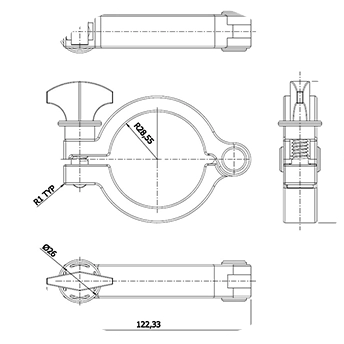
• I wonder about the quality of the ferrules (pipes) and the clamps.
• I want to know when the ‘failed’ gasket was installed, who installed it and what regime was in place to maintain it.
• I enquire about the process that led to that specific gasket being used in the area in question.
• I ask about the workload of the clamp, has it been used elsewhere with a different role?
• I look into the temperatures involved and whether the clamp has been adjusted.
In short, I try to build a full picture of the scenario, rather than homing in on the poor gasket that couldn’t take the strain any more.
9 times out of 10 in any failure that occurs, involving a gasket, the incident is due to the device being badly fitted, maintained or used within an inappropriate context. Coming across a ‘bad’ gasket is incredibly rare, it’s usually just the wrong bit of kit in the wrong place at the wrong time.

How do we solve these issues? For me, training is vital. Just like the lieutenant sending the rookie cop back to the academy to brush up on their crime scene basics, people throughout the high purity industry must have adequate and regular training to reduce the likelihood of these incidents occurring again.
Only then can we clear the good name of gaskets, once and for all.
Murph
If you’d like puretransfer.com to share our know-how with you and your business, drop us a line – [email protected]