

On 26th June 1974, a cashier at Marsh Supermarket in Troy, Ohio, scanned a ten-pack of Wrigley’s Juicy Fruit chewing gum across a reader and heard a beep. It was the first product ever to be sold using a barcode. Any pub quizzers out there, will surely store away this information.
The gum itself was unremarkable. Wrigley’s had been making it since 1893. The flavour hadn’t changed. The ingredients hadn’t changed. The packaging had barely changed. What had changed was this: for the first time, the product could identify itself.
SCAN: VALID
MATCH: CONFIRMED
PRICE: $0.67
TIMESTAMP: 08:01 AM – 26 JUNE 1974
Before the barcode, every item in a supermarket was essentially anonymous at the point of sale. A cashier had to recognise it, remember its price, and key it in manually. Mistakes were common. Speed was limited. Stock control was an educated guess. The product existed, but the system around it had no reliable way to know what it was.
The barcode didn’t change the product. It gave the product an identity that the system could read instantly, reliably, and without human interpretation.
A high purity process line in a pharmaceutical or biotech facility has, until recently, had much in common with a pre-barcode supermarket shelf.
Every fitting is present. Every fitting has a specification. Everything is documented somewhere in the system. But at the point of physical interaction – when a technician needs to identify what they’re looking at, confirm it’s the right component for the job, and verify its specification – there is nothing on the component itself that communicates any of this.

The remarkable thing about the barcode is that it solved a problem most people hadn’t articulated clearly. Supermarkets worked before barcodes. Products were sold. Checkouts functioned. But there’s a persistent, low-level friction at every point where a human being had to identify a product – and that friction accumulated into errors, delays, and losses that the industry had simply accepted as the cost of doing business.
The barcode didn’t make supermarkets more complex – it made them more readable. It converted the implicit information that already existed about every product into something the system could use automatically, at speed, without ambiguity.
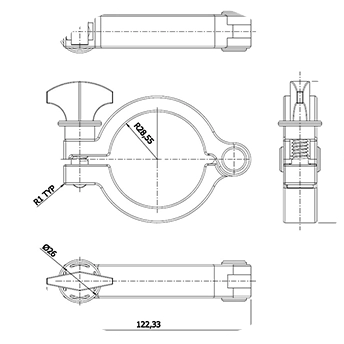
A colour-coded tri-clamp fitting system does precisely the same thing for a process line. The specifications already exist. The information is already there. Colour coding converts that implicit information into something that can be read at a glance, by anyone, at the moment it matters most.
The barcode didn’t invent product identity. It made product identity readable. A colour-coded fitting system doesn’t invent specifications – it makes specifications visible. The principle is identical. The impact, in a regulated high purity environment, can be just as transformative.
The gum that was scanned in Ohio in 1974 was never chewed. It’s now in the Smithsonian Institution. It sits in a display case as an object that changed commerce, logistics, and supply chain management globally – not because of what it was, but because of what it demonstrated was possible when identity becomes readable.
Every fitting on your process line has an identity. The question is whether that identity is readable to the person who needs it, when they need it.
Make your process
line readable.
Pure Transfer brings clarity and identification to high purity fluid transfer systems in regulated environments.
Talk to our team