

In 1967, colour television didn’t just change how people watched snooker. It saved it.
Before colour TV, snooker was a black and white blur of barely distinguishable balls on a grey table. Nobody could follow it. Nobody particularly cared. The commentators did their best, but when every ball looks the same shade of grey, even the most passionate description in the world can’t manufacture excitement.
Then colour arrived. And suddenly the reds, yellows, greens, browns, blues, pinks and blacks popped off the screen. The game became visual. Watchable. Compelling. You didn’t need to know the rules to understand what was happening — you could simply see it.
The rest, as they say, is history. Snooker went from a gentlemen’s club curiosity to one of the most-watched sports on British television — not because the game changed, but because people could finally see it properly.
I’ve been thinking about that a lot lately.
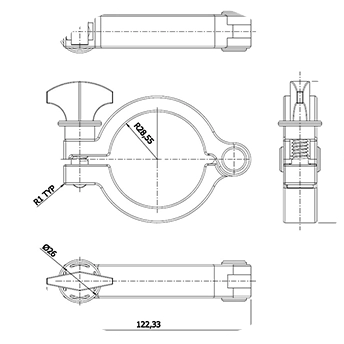
Because for decades, high purity tri-clamp style fittings have lived in exactly the same world snooker used to inhabit — a sea of indistinguishable stainless steel. Every clamp looking like every other clamp. Size, pressure rating, material grade, application — none of it visible at a glance. You either knew, or you guessed. And on a busy process line in a pharmaceutical or biotech facility, the opportunity for the wrong fitting in the wrong place is never far away.
In a high purity environment, guessing is not an option.
The consequences of a misidentified fitting aren’t just operational. In regulated environments — pharmaceutical manufacturing, biotech, food and beverage — they can mean batch failures, compliance breaches, and in the worst cases, genuine safety risk.

Coloured clamps change that. Instantly.
A well-implemented colour-coding system turns a walk down a process line into something you can actually read. Right size. Right pressure rating. Right material. Right application. Right there — visible, unambiguous, and verifiable at a glance without reaching for a manual or calling over an engineer.
Think about what that means for a maintenance technician working under time pressure. For a validation engineer signing off a new line installation. For a new team member who hasn’t yet memorised the full catalogue of fittings on site. Colour communicates where words and numbers require interpretation.
It’s the same cognitive shortcut that makes traffic lights work, that makes electrical wiring colour-coding a safety standard, and that made snooker worth watching on a Saturday afternoon.
Snooker didn’t need better players when colour TV arrived. It needed to be seen properly. Maybe high purity pipework just needed the same.
There is a broader point here too. The high purity sector is advancing rapidly — smarter monitoring, real-time data, predictive maintenance, ALCOA++ compliant digital records. The technology at the connection level is becoming increasingly sophisticated.
But even the most advanced system benefits from the simplest layer of visual clarity at the point of installation. Colour coding isn’t a replacement for rigorous process — it’s a foundation for it. It reduces the margin for human error before any data is even captured.
Sometimes the most powerful innovations aren’t the most complicated ones. Sometimes it’s just a matter of being able to see things properly.
Just ask snooker.
Want to know more?
Pure Transfer specialises in high purity fluid transfer solutions for pharmaceutical, biotech, and regulated process environments.
Get in touch with our team